

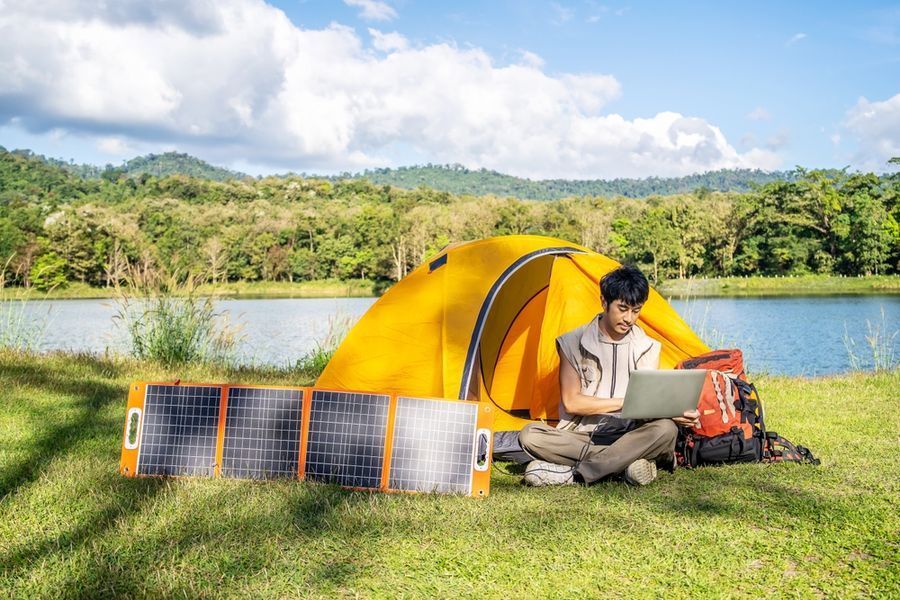
The right solar charger can keep your phone, headlamp, and GPS running long after the last campground outlet is behind you. With so many panels on the market, it helps to focus on models that have actually been put through real-world use rather than just slick marketing. The five chargers below cover everything from ultralight thru-hikes to long basecamp weekends, so you can pick the one that best fits the way you actually camp and travel.
1) BigBlue SolarPowa 28: Best All-Around Pick
The BigBlue SolarPowa 28 is a 28-watt monocrystalline folding panel that weighs 20.9 ounces and folds down to about 11 by 6 by 1.5 inches (source). It has one USB-A port and two USB-C ports, with each port delivering up to 2.4 amps, so it can charge up to three small devices at once.
In one hour of direct sun on a 10,000 milliamp-hour test battery, this panel produced 2,177 milliamp-hours of charge, and it still pulled in 583 milliamp-hours under simulated cloudy conditions (source). That kind of consistent output in both bright sun and partly cloudy weather makes it a strong choice for car camping, road trips, and long weekends in the backcountry where conditions can shift hour by hour.
2) FlexSolar E10 Mini: Best for Ultralight Backpacking
At just 7.3 ounces, the FlexSolar E10 Mini is the smallest and lightest panel in this group. It unfolds into a four-panel array measuring 19.2 inches long, then collapses down to a size smaller than many smartphones, so it tucks easily into a hip belt pocket or the lid of a pack (source).
The single USB-A port puts out up to 2 amps and is best used to top off a small power bank that you then use to charge phones and headlamps. In one hour of direct sun, the E10 Mini generated 1,247 milliamp-hours of charge, which is impressive for such a tiny unit (source). If every ounce in your pack matters, this is the one to clip on.
3) Blavor 10W: Best Lightweight Budget Pick
The Blavor 10W is a bi-fold, monocrystalline 10-watt panel that weighs 12.6 ounces and folds down to a 7.5 by 7.5 by 1 inch square (source). It has a velcro storage pouch sized for a battery bank and cables, plus carabiners and loops for hanging it from a pack or a tent line.
In one hour of direct sun, the panel produced 1,401 milliamp-hours of charge, outperforming several larger 20 and 30-watt panels (source). Under simulated cloud cover, it still pulled in 295 milliamp-hours, more than half of the other panels in the lineup. It is a strong all-rounder for budget-minded campers and weekend travelers who do not want to spend big on a first solar panel.
4) FlexSolar 40W: Best for Power Stations and Group Trips
The FlexSolar 40W unfolds into six durable panels measuring 49 inches long, and folds back down to about 11 by 7.5 by 1 inch (source). At 47.3 ounces, it sits on the heavier end of "portable," but that extra size is what lets it push real power for bigger setups and group trips.
Along with USB-A and USB-C outputs, it has a DC output for plugging into a portable power station, which is unusual in this size class. In one hour of direct sun, it generated 1,573 milliamp-hours through its USB output and 2,200 milliamp-hours through its DC output on a 240-watt-hour power station (source). If your trips include laptops, larger lights, or a small camp fridge, this panel can keep them fed.
5) Goal Zero Nomad 20: Best for Basecamp and Car Camping
The Goal Zero Nomad 20 is a 20-watt foldable panel weighing about 2.28 pounds, with a built-in kickstand for angling the face toward the sun (source). It includes a USB port rated at 5V and 2.1 amps along with an 8mm solar port for connecting to compatible power stations and battery packs.
The Nomad 20 has less of a drop-off from direct to indirect light than almost any other panel in this category, which makes it dependable in mixed weather (source). It can also be daisy-chained with other compatible panels, so you can add more wattage as your basecamp grows. Its weather-resistant build can handle a light drizzle, though it should not be submerged.
Matching the Right Panel to Your Trip
The best solar charger for your trips is the one that matches how, where, and how long you camp. For lightweight backpacking, lean toward the FlexSolar E10 Mini. For mixed weekends and reliable all-around performance, the BigBlue SolarPowa 28 is a safe bet. The Blavor 10W is a smart budget option, while the FlexSolar 40W and Goal Zero Nomad 20 shine when you need real wattage at basecamp or in a campervan.
No matter which one you choose, plan to pair the panel with a small power bank so you can store energy during peak sun and use it later, when the sun has dropped behind the trees. Take time to learn how to angle the panel for your latitude and time of day, since even a small tilt toward the sun can pull in noticeably more power. With a bit of practice, you will get far more useful charge out of every hour of sunshine and worry a lot less about a dying phone or headlamp out on the trail.