

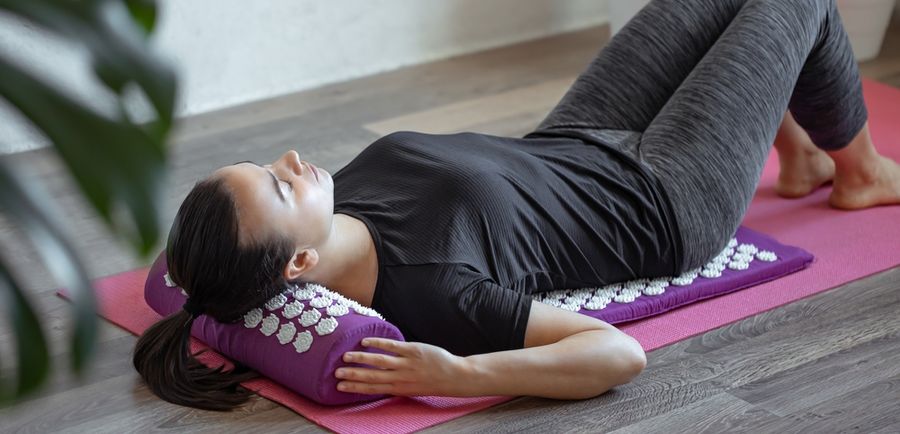
After a long day, tension has a way of settling deep into your muscles. Your shoulders feel tight, your back aches, and your mind won't slow down. For many Americans, end-of-day stress has become routine — and finding simple, effective relief at home isn't always easy. Acupressure mats are a growing tool in at-home wellness, and they may offer a surprisingly low-effort way to ease that evening tension and help your body wind down.
What Is an Acupressure Mat?
An acupressure mat is a flat pad covered with hundreds of small plastic spikes. When you lie, sit, or stand on it, those spikes press into the skin at many points at once. The idea is rooted in acupressure, an ancient practice from traditional Chinese medicine that has been used for more than 3,000 years (source). Instead of a trained practitioner using their hands to apply pressure to specific spots on your body, the mat does that work on its own — no appointment needed.
Unlike acupuncture, no needles are involved. The spikes press — but do not break — the skin, making an acupressure mat a non-invasive tool that most people can use at home without any special training (source). They come in different sizes: larger mats let you lie down for full-body relaxation, while smaller pads can target areas like the feet or neck (source). The flexibility in how you use them makes them easy to fit into an evening routine.
How Evening Tension Affects the Body
Physical tension tends to build up quietly throughout the day. Whether you've been sitting at a desk, standing on your feet, or just carrying the mental load of a busy schedule, that stress rarely disappears on its own when you walk through the door. Muscle tightness, a racing mind, and trouble winding down are all common signs that your body is still in "on" mode long after the workday ends.
This matters because unresolved tension doesn't just feel unpleasant — it can get in the way of sleep, recovery, and overall well-being. When the body holds on to stress late into the evening, the nervous system stays more active than it should be. Finding ways to guide the body toward a calmer state before bed is a key part of feeling rested and restored. This is where a consistent, simple tool like an acupressure mat can be worth trying.
How the Mat Helps You Relax
When you lie down on an acupressure mat, the pressure from its spikes may help boost blood flow in the areas being stimulated, which can ease muscle tightness (source). One small study found that people using these mats showed signs of improved circulation, along with lower heart rates and slower breathing — both signs of a more relaxed state (source). The physical sensation the mat creates shifts within the first few minutes from something sharp and uncomfortable to a warm, spreading feeling that many people describe as deeply relaxing.
There is also a hormonal side to what the mat may do. Each session may trigger the release of endorphins and oxytocin — natural chemicals that support feelings of calm and well-being — while helping bring down levels of cortisol, the body's main stress hormone (source). It is worth noting that while people who use these mats often report a clear sense of calm, the science is still catching up: some studies suggest that measurable changes to things like blood pressure and cortisol levels are not always consistent, and more research is needed (source). Even so, the reported benefits of relaxation and reduced tension are widespread among users.
Acupressure Mats and Sleep Quality
For many people, evening tension and poor sleep go hand in hand. When your body hasn't had a chance to let go of the day's stress, falling asleep — and staying asleep — becomes harder. Regular use of an acupressure mat before bed has been found to calm the nervous system and help prepare the body for rest (source). A notable share of mat users turn to them specifically for sleep-related concerns, including trouble falling asleep and waking up through the night (source).
The initial sensation on the mat plays an interesting role here too. Studies show that any discomfort from the spikes tends to peak in about 30 seconds and then fades (source). After that, the warm and tingly feeling that follows is a big part of what makes the mat useful at night. Many users find that pairing a mat session with slow, steady breathing creates a mini wind-down ritual that signals the body it's time to rest.
How to Add a Mat to Your Evening Routine
Getting started is straightforward. You can lay the mat flat on the floor or a bed and simply lie back on it. Beginners often find it helpful to place a thin shirt or light cloth between the skin and the mat at first, and then transition to direct skin contact as comfort grows (source). Most people benefit from sessions between 10 and 30 minutes, and starting with just five to ten minutes is perfectly fine (source). Many users find the benefits become more noticeable after passing the ten-minute mark (source).
Acupressure mats are not a cure for chronic conditions and are not a replacement for medical care. People who are pregnant, have a bleeding disorder, diabetes, or sensitive or thin skin should speak with a doctor before using one (source). For most healthy adults, though, adding a mat to an evening routine is a low-risk, low-cost way to ease daily tension and support a calmer, more restful end to the day.
A Simple Step Toward Calmer Evenings
Evening tension is something most of us know well, but it doesn't have to be a fixed part of the end of every day. Acupressure mats offer a practical, easy-to-use option for people looking to take the edge off without relying on medication or expensive treatments. In a large user survey, nearly all participants reported a positive experience, and many noticed results within just the first few sessions (source).
The most meaningful thing about acupressure mats may be the quiet space they create. Lying still for ten to twenty minutes — breathing deeply, away from screens and noise — gives your nervous system room to shift into a lower gear. Whether the mat's effects come purely from that pause, from the physical stimulation itself, or from a mix of both, the outcome is one worth chasing: a body and mind that are genuinely ready for rest.